Bank Reconciliation Statement: Advantages and Disadvantages

The short version: the advantages of a bank reconciliation statement are that it catches fraud and recording errors early, plus bank charges your ledger never saw. The ACFE puts the median fraud case at $104,000, with an average above $1.4 million. The cost is the hours a manual PDF match takes.
Each year, organizations lose an estimated 5% of their revenue to occupational fraud. That is the ACFE's 2026 estimate, drawn from 2,402 cases across 143 countries. A bank reconciliation statement is one of the ordinary controls that surfaces that kind of loss.
The advantages and disadvantages of a bank reconciliation statement pull in opposite directions. Reconciling catches money problems while they are still fixable. Doing it by hand costs hours of matching an Excel sheet against the statement line by line, before anything reaches QuickBooks.
What is a Bank Reconciliation Statement?
The bank reconciliation statement (BRS) defines the financial comparison between your internal cash records and a bank statement. It thus discovers differences that arise from timing differences such as outstanding checks, errors, or even fraud.
Think of it as a very informative "finance fact-check" whereby every transaction gets verified to align with the other across both records.
Why is Bank Reconciliation Important For a Business?
Bank reconciliation is not a chore or an administrative activity. It protects financial assets. Suppose businesses do not reconcile their bank statements. In that case, they can easily work under a false premise concerning their financial position, resulting in cash flow problems, overdraft situations, or unnoticed fraud.
Companies can catch early errors, unauthorized withdrawals, or even recorded fees before unmanageable problems build. Aside from finding errors, reconciling acts as an important tool in the financial planning process.
How Often Should a Bank Reconciliation Statement Be Completed?
The frequency of reconciliation depends on the size and nature of the business. For small businesses with low transaction volumes, monthly reconciling (in sync with bank statements) may be sufficient.
However, companies processing hundreds of transactions daily, such as retail stores or e-commerce businesses, should consider weekly or daily reconciliations. More frequent reconciliations make early detection of issues possible.
For instance, if a charge is recognized as fraudulent a couple of days after a transaction, it can be disputed, potentially preventing financial loss. If a company has cash flow problems, frequent reconciliations prevent overdrafts.
Cadence is a time-allocation decision: transaction matching already takes 30 to 40% of a finance professional's time, per a PwC benchmarking study.
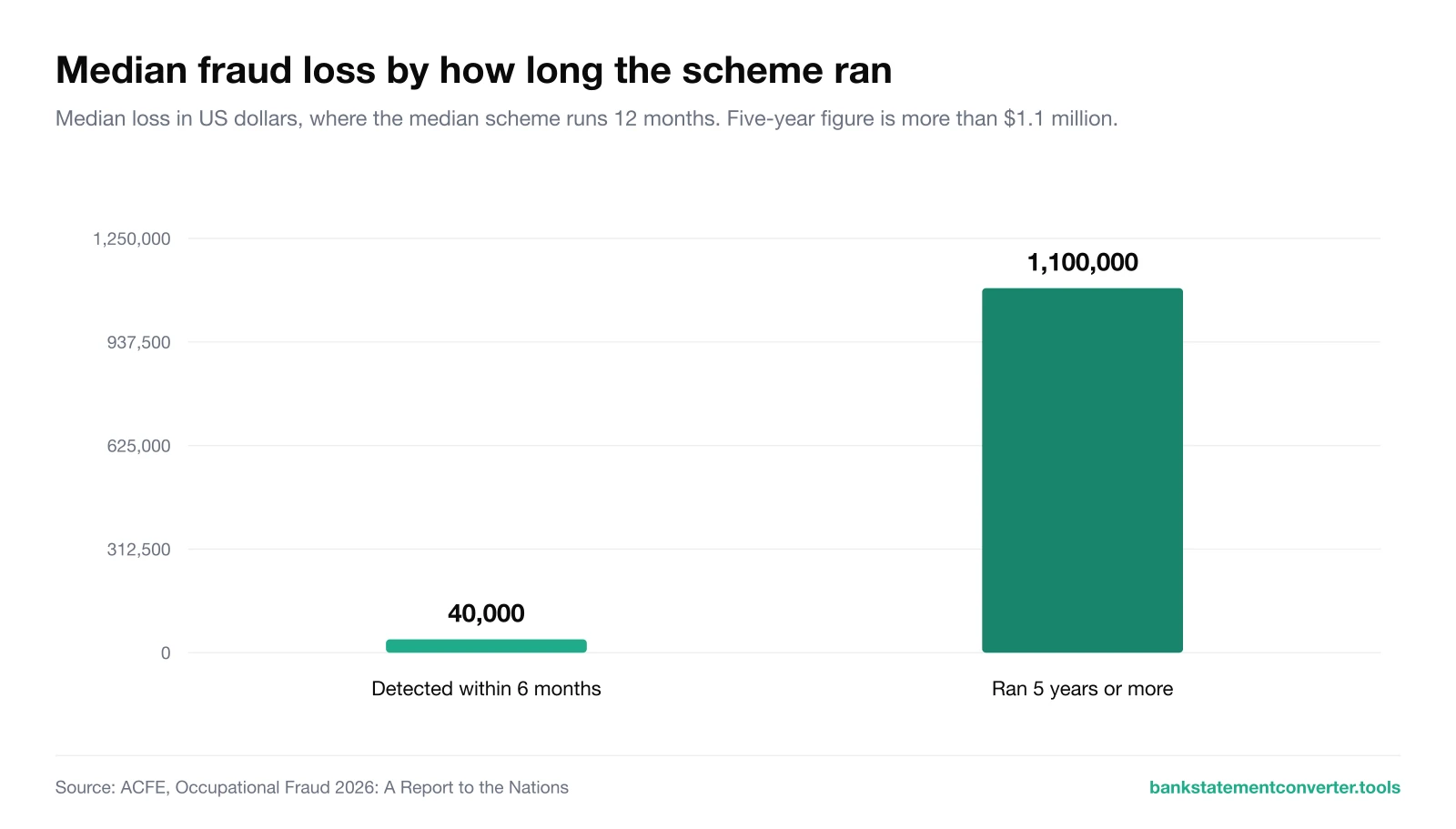
On ACFE 2026 data, the median fraud scheme runs 12 months before detection. Inside six months the median loss is $40,000; past five years it passes $1.1 million.
Advantages of a Bank Reconciliation Statement
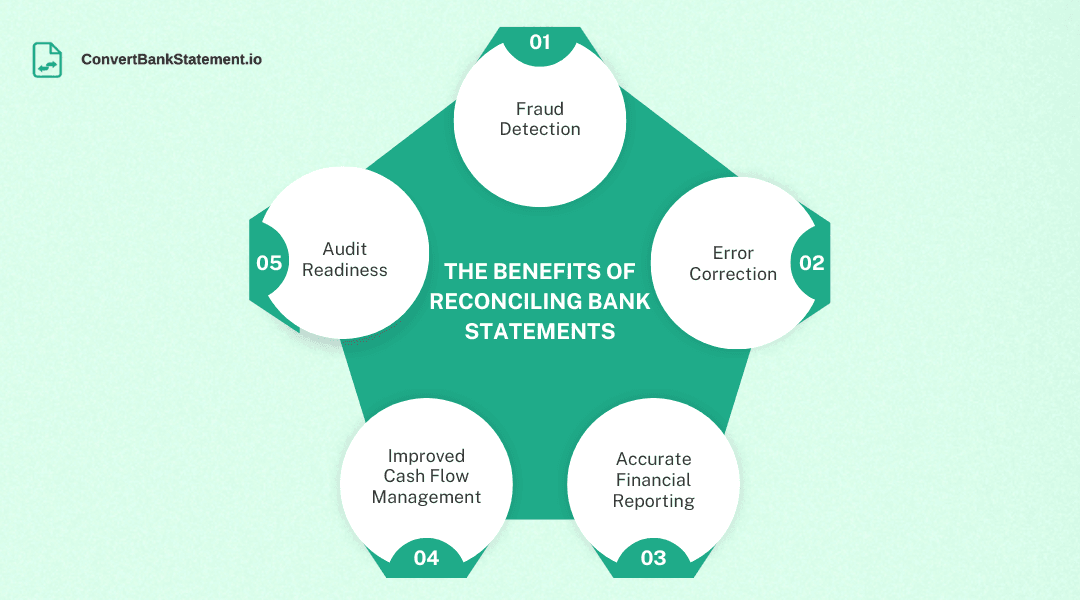
The advantages of a bank reconciliation statement come down to catching what one record knows and the other does not. Reconciling surfaces unauthorized transactions and recording errors, plus bank charges nobody logged, while the amounts are still disputable. The cost is time.
Accountants shorten it to BRS, and the advantages of BRS are the same either way.
1. Fraud Detection
Unauthorized transactions, altered checks and internal embezzlement add up: the ACFE median is $104,000 per case. By reconciling accounts monthly, you can pick up any irregularities immediately.
A situation where a $1,500 vendor payment is incorrectly recorded as $15,000 can be identified during reconciliation. This assists a business in preventing cash flow disruptions. Automation also improves detection by identifying the anomaly in real time.
Asset misappropriation, the category reconciliation surfaces most often, is 90% of fraud cases. Tips catch 43% of them, so reconciliation is one control among several. It doesn't catch a payment both records agree on: a fake invoice paid by transfer clears both sides.
2. Error Correction
The banking system is not perfect. Some tiny errors, such as a misplaced decimal, duplicate payment, or an unrecorded fee, could paint a slightly distorted picture of your financial situation. Reconciliation catches those errors early.
For example, a check cleared for $470 was logged as $370. This error became clear during reconciliation.
3. Accurate Financial Reporting
Investors and lenders require accurate information. And since reconciliation directly affects your financial statement, its accuracy determines investor confidence and loan approvals.
By keeping account of deposits in transit, outstanding checks, and bank fees, reconciliation confirms that your balance sheet reflects reality.
For instance, a $20,000 deposit missing from your bank statement would inflate your books without reconciliation.
4. Improved Cash Flow Management
Knowing your correct cash position prevents overdrafts and optimizes liquidity. A retail business, for example, can avoid a $300 overdraft fee by spotting an unprecedented check during reconciliation.
5. Audit Readiness
Auditors scrutinize reconciled accounts. A clean bank reconciliation statement simplifies compliance and builds trust with stakeholders. Automated matching leaves a timestamped trail of every adjustment.
Disadvantages of Bank Reconciliation
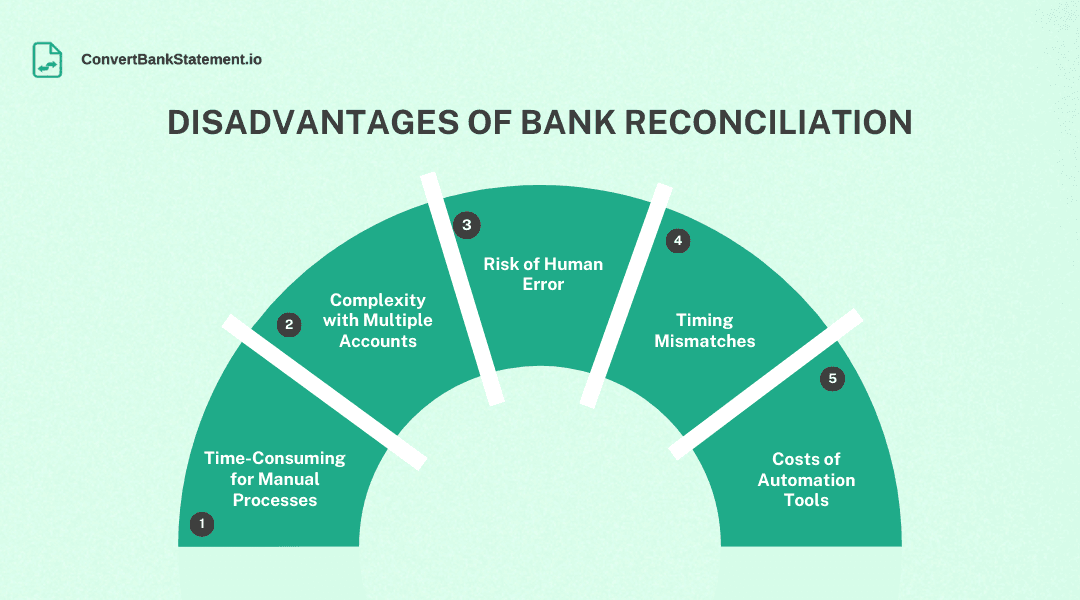
The disadvantages of a bank reconciliation statement are one cost in different forms. Manual matching takes hours, and multiple bank accounts multiply them. Typing rows by hand adds errors. Checks in transit hide the real balance. Software removes the work and charges for it.
1. Time-Consuming for Manual Processes
A manual match consumes hours. For multinationals, this issue escalates exponentially, diverting resources from strategic tasks.
2. Complexity with Multiple Accounts
Businesses using several banks face reconciliation chaos. A single missed transaction in one account can cause errors across financial statements.
3. Risk of Human Error
Manual data entry invites mistakes. A transposed digit or duplicated row surfaces only when the two balances refuse to meet.
4. Timing Mismatches
Checks lingering in transit create confusing cash flow projections. A $2,500 check delayed by a vendor, for instance, may falsely inflate your ledger balance.
5. Costs of Automation Tools
Upfront costs deter small businesses. A subscription is a fixed cost against the hours you already pay.
Solutions powered by OCR bank statement technology and bank statement extraction tools help streamline this process, especially when dealing with PDF formats and scanned documents. However, the long-term ROI in saving time and preventing fraud often justifies the investment.
Automated extraction carries its own caveat. OCR can misread digits on low-quality or handwritten scans, so check the totals against the statement.
Not every business needs one. At low volume a spreadsheet still costs less than a licence.
Causes of Difference in a Bank Reconciliation Statement
Your ledger and your bank statement disagree for four ordinary reasons, and only one of them is a mistake. The other three are timing: your record and the bank's are on different clocks, and each of those gaps closes by itself.
- Outstanding checks: recorded by you, not yet presented. Your balance reads lower than the bank's until they clear.
- Deposits in transit: recorded by you, not yet credited. Your balance reads higher until they post.
- Bank-side entries you never recorded: service charges, interest, NSF returns. The bank posts these without asking.
- Recording errors: an amount keyed wrong, or posted to the wrong account. The only one that is actually wrong.
The recording error is the one that will not clear itself. A fixed working order is what bank reconciliation audit procedures are for.
Best Practices to Maximize Benefits
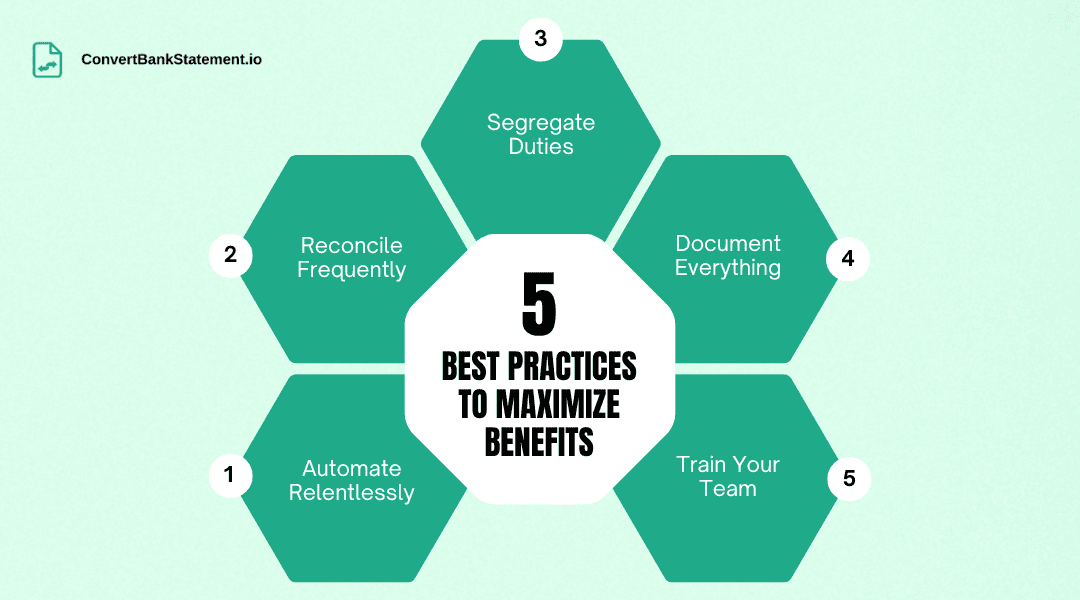
Every practice that works shrinks the gap between a transaction and the person checking it. Automation clears the easy matches. Frequency keeps each batch small. Separate duties stop one person owning both sides. Written records let an auditor retrace what you did.
1. Automate Relentlessly
QuickBooks auto-matches transactions by amount and date, and flags what it cannot pair. Real-time dashboards highlight discrepancies instantly. This works best when bank statements are imported into Excel in a structured format.
2. Reconcile Frequently
Daily or weekly checks prevent error pile-ups. A daily match takes minutes on yesterday's transactions and hours on last month's, because you still remember the entries.
3. Segregate Duties
Assign reconciliation to someone independent of cash handling. This internal control reduces fraud risk.
4. Document Everything
Maintain logs of adjustments, voided checks, and NSF transactions. Pair this with proper bank statement verification to ensure records haven’t been tampered with or misrepresented. Cloud-based systems like Xero auto store records for audits.
5. Train Your Team
Educate staff on reconciling tools and red flags (e.g., unexpected fees). The ACFE puts the median loss at $84,000 where staff had fraud awareness training, against $150,000 where they did not.
Conclusion
Bank reconciliation is a double-edged sword: its benefits, fraud prevention, accuracy, and compliance, far outweigh the drawbacks of time and complexity, especially with automation. This is even more effective when combined with categorizing bank transactions in Excel, which gives clarity to cash flows and spending habits.